Here's What's on the Books Today.
Aon agreed to acquire USI for $17 billion, building on its 2024 NFP acquisition. The headline is consolidation: scale and middle-market access are reshaping insurance distribution again.
Whether you sit on the carrier, broker, or vendor side, the practical questions are the same:
Press releases will not answer those. The data in Benefeature can.

On August 31, 2026, Aon announced an agreement to acquire USI Insurance Services from KKR for approximately $17 billion, with closing expected in the fourth quarter subject to regulatory approval.
USI is among the largest insurance brokers in the U.S., with roughly $3 billion in annual revenue, 10,500+ employees, and nearly 200 offices. Aon CEO Greg Case framed the combination as establishing a premier U.S. middle-market platform, following Aon's 2024 acquisition of NFP.
The corporate story is scale: one of the world's largest brokers assembling a middle-market distribution engine. The market story is different, and more useful for group benefits teams: distribution is concentrating fast, and the relationships that matter (broker offices, employer books, carrier panels) do not reorganize on announcement day.
Source: Deal terms and executive statements in this section are drawn from CNBC's reporting on the Aon-USI agreement (August 31, 2026).
Middle-market employers sit in the sweet spot for group benefits: large enough for meaningful premium, small enough that broker relationships and local office production still drive placement decisions.
When broker organizations consolidate at this scale, a few things shift:
The question is not whether consolidation is happening. It is whether your organization can see what's on the books (USI, Aon, NFP, and the producing offices underneath) while the market reorganizes.
Worth stating plainly: a deal announcement is not a filing event.
Until plans renew and new Form 5500 submissions hit the Department of Labor:
Do not expect a single merged entity to appear in the data the week the deal closes. What does change immediately is the strategic calculus: teams need a clear read on USI and Aon production now, before integration shifts books, offices, and relationships over the next 12–24 months.
This is where public filing data and Group Benefits Intelligence diverge from a generic M&A recap. In Benefeature, teams across the market can already:
Search USI as a resolved broker firm, not a dozen raw strings from unprocessed filings. Open the broker firm profile and see employers on the book, carriers on each account, premium modeled across 23 benefit product categories, and producing offices, not just the central filing hub that mailed the form.
A raw 5500 export shows a broker name on a filing. It does not show that a Dallas office wrote voluntary across 40 employers with specific carriers, at least not without weeks of manual cleanup.
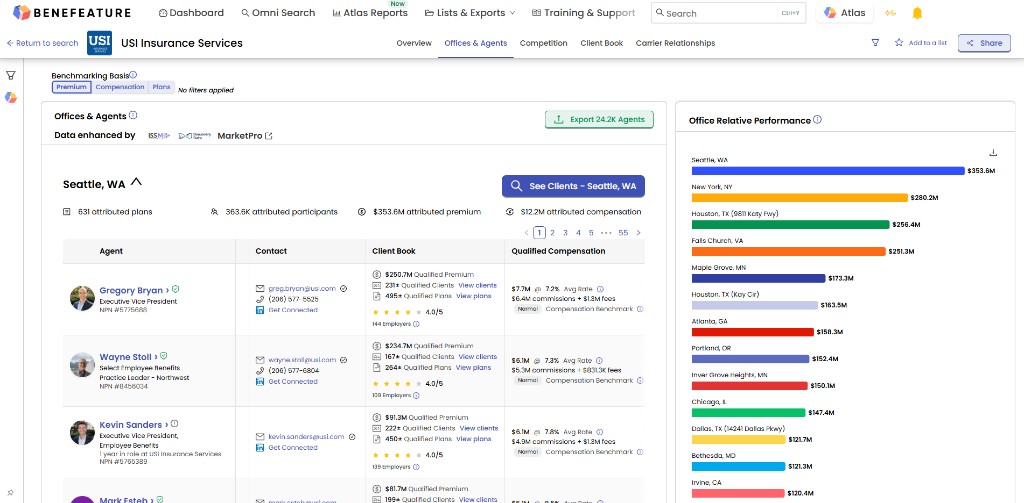
The same workflow applies to Aon and to NFP offices that may still file under legacy names from the 2024 acquisition. Filter by state or custom territory, the product lines you care about, and office size, premium, and client count. The strategic picture is Aon + USI + NFP, even when the data still shows three naming worlds side by side. The same Offices & Agents and Client Book views are available for each resolved broker firm.
The high-value move is not "find USI" in the abstract. It is which employers sit on a USI office book, which carriers or providers are on the panel, what's in force by product line before an RFP or renewal conversation, and which broker agents are tied to those plans, with contact information where available.
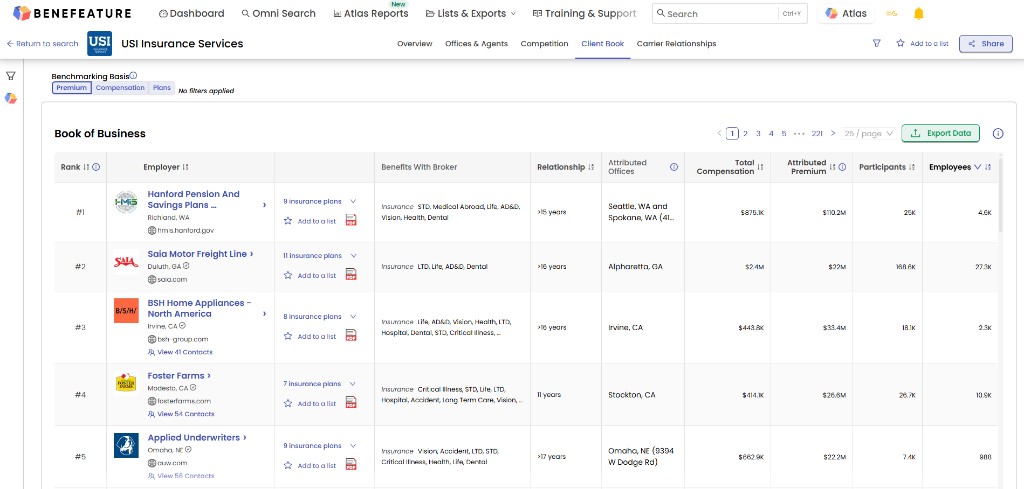
Watch growth and shrinkage over time at the office level. Which USI offices are gaining employers? Which are flat or declining? That signal often shows up in filings before an org chart update. Learn more about how this works in our Broker Filing Hub feature and our guide to broker attribution.
Want to walk the USI book in your own territory? We can show you live.
Book a meetingIntegration plays out in public data over months and years. Typical patterns:
| What you may see | Why it matters |
|---|---|
| USI, Aon, and NFP name strings appearing side by side on filings | Entity resolution has to catch up to corporate branding |
| More plans filing from consolidated lockbox offices | Filing-hub distortion increases, not decreases |
| Books shifting between producing offices | Office-level attribution becomes more important, not less |
| Carrier mix changes on employer accounts | Displacement and retention signals surface in filings before a partnership review |
Benefeature maintains a curated affiliation crosswalk of 1,000+ broker mergers and acquisitions, updated as the market moves. Entity resolution re-runs across the full universe monthly. As USI filings begin mapping under Aon, users see the shift in attributed books and office production without rebuilding spreadsheets every quarter.
Consolidation does not hit one org type. The same filing data matters to different roles for different reasons. A few examples:
Consolidation does not simplify the market map. It raises the cost of guessing, no matter which side of the table you sit on.
Aon + USI is the latest move in a clear direction: scale, consolidation, and middle-market access are becoming central to insurance distribution strategy. NFP pointed the same way in 2024. This deal is larger, and closer to the distribution layer where most of the group benefits market actually moves.
The organizations that adapt fastest will not be the ones with the best read on press releases. They will be the ones who can answer, from data: what's on the USI and Aon books, which offices are growing, and which employer relationships may move next.
That is Group Benefits Intelligence: clean, modeled, office-attributed market data you can act on while the market reorganizes.
Book a meeting with our team for a walkthrough of office-level broker attribution, attributed books of business, and how strategy, sales, and distribution roles use Benefeature when the market consolidates.
Discover why Form 5500 broker attribution is often wrong and how office-level attribution transforms group benefits market intelligence.
Learn how product-level modeling, office-level attribution, and integrated signals transform reporting into intelligence.
